

Product Overview
An industrial plastic extruder melts, conveys, and processes thermoplastic polymers into continuous profiles, pipes, sheets, films, and compounded pellets. Selecting the correct extrusion system requires aligning machine design with polymer rheology, feedstock conditions, required output, and downstream processing demands.
Single-Screw Extruder
Single-screw extruders are engineered for continuous thermoplastic processing where stable conveying, melting, and pressure generation are critical. Primary applications include high-speed pipe extrusion, profile manufacturing, and sheet production. Selection parameters--such as screw diameter, length-to-diameter (L/D) ratio, drive power, and flight geometry--are tailored to specific resin characteristics and volumetric targets.
Twin-Screw Extruder
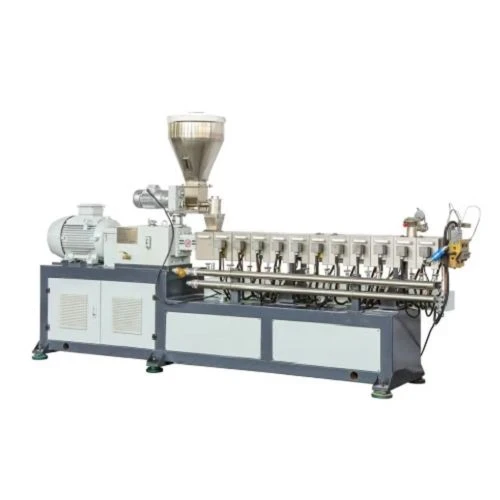
Co-rotating twin-screw extruders are utilized for polymer compounding, masterbatch production, reactive extrusion, and formulation modification. They provide intensive distributive and dispersive mixing for high-filler or additive-heavy systems. Screw configuration, processing length, feeding setups, and venting modules are customized around specific formulation objectives.


Key Features & Operational Benefits
Optimized Screw and Barrel Metallurgy
Screw geometries and barrel configurations are engineered for specific polymer matrices. For abrasive or glass-fiber-reinforced formulations, systems incorporate wear-resistant bimetallic barrel liners and hardened alloy weld overlays on screw flight tips.
High-Torque Drive Transmission
Heavy-duty gearboxes with hardened, precision-ground gear flanks deliver high service factors, supporting continuous high-torque output under demanding industrial loads.
Multi-Zone Thermal Management
Closed-loop temperature control loops pair cast-aluminum or ceramic band heaters with internal barrel cooling channels, maintaining thermal tolerances across processing zones.
Precision Feeding Systems
Modular feeding layouts accommodate the physical form and flow behavior of raw materials, supporting pellet, powder, or side-feed configurations alongside accurate additive dosing.
Effective Devolatilization
Multi-stage vacuum venting ports extract residual moisture and volatile organic compounds directly from the melt stream, preventing surface defects and structural surging in the final product.
Technical Specifications
The following table outlines standard industrial extruder configurations. All parameters can be re-engineered to meet specific project criteria.
|
Parameter |
Single Screw Series A |
Single Screw Series B |
Twin Screw Series A |
Twin Screw Series B |
|
Screw Diameter |
65 mm |
90 mm |
52.5 mm |
71.0 mm |
|
L/D Ratio |
30:1 to 33:1 |
30:1 to 34:1 |
36:1 to 48:1 |
36:1 to 52:1 |
|
Motor Power |
45 to 55 kW |
90 to 110 kW |
75 kW |
160 to 200 kW |
|
Reference Screw Speed |
120 rpm |
100 rpm |
600 rpm |
600 rpm |
|
Reference Output |
120 to 180 kg/h |
250 to 380 kg/h |
150 to 250 kg/h |
450 to 700 kg/h |
Manufacturing & Quality Control
Dimensional Verification
Barrel bores and screw profiles undergo strict coordinate measuring and deep-hole inspection to verify straightness, pitch accuracy, and flight depth against engineering drawings.

Dynamic Rotor Balancing
High-speed screw assemblies are dynamically balanced to mitigate mechanical vibration and bearing wear during continuous high-RPM operations.

Factory Run-Testing
Extrusion units undergo multi-hour mechanical dry runs and thermal cycling tests to log motor amperage, gearbox operating temperatures, and torque draw prior to crating.
Traceability Documentation
Material Test Reports and quality inspection records are provided for pressure-bearing components, drive shafts, and barrel assemblies.
Customization & System Configuration
Screw & Barrel Engineering
Custom flight profiles, compression ratios, and material selections based on polymer melt flow indices and filler content.
Drive Integration
Vector-controlled AC motors, permanent magnet synchronous motors (PMSM), and heavy-duty gearboxes matched to processing torque demands.
Automation & SCADA Integration
Programmable logic controllers (PLC) paired with industrial touch-screen HMIs, supporting standard industrial communication protocols for centralized plant data logging.
Downstream & Auxiliary Interfaces
Custom adapter flanges, melt pumps, gravimetric dosing units, and die head connections engineered to match existing plant infrastructure.
Typical Applications
Compounding & Masterbatch
Co-rotating twin-screw systems designed for uniform polymer blending, mineral filler dispersion (CaCO3, talc), and colorant incorporation into polyolefin carriers.
Pipe & Profile Extrusion
Single-screw lines configured for high-speed, stable output of industrial pressure pipes, utility water conduits, and rigid architectural profiles.
Recycling & Pelletizing
Extrusion systems engineered with targeted filtration and devolatilization to transform washed agricultural films, regrind flakes, and post-industrial scrap into uniform pellets.
Sheet & Board Production
Extruders delivering pulsation-free, homogeneous melt streams for multi-layer cast sheets, thermoforming webs, and composite decking boards.
Frequently Asked Questions
We are one of the most professional plastic extruder manufacturers in China, featured by quality products and good low price. Please rest assured to buy discount plastic extruder made in China here and get quotation from our factory. Customized orders are welcome.
Twin Screw Rubber Extruder, Pe Single Screw Extruder, Twin Screw Pelletizing Extruder